
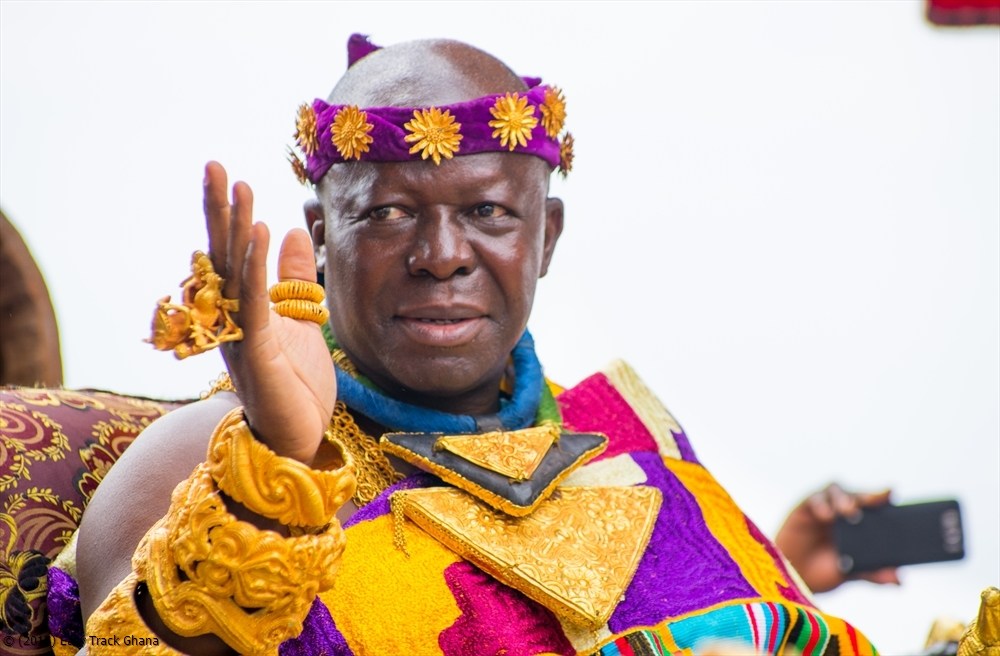
The Asantehene, Otumfuo Osei Tutu II, has called on Ghana to harness the economic potential of its creative industry by investing in local talent, strengthening production capacity and improving technical skills.
He believes the country’s fashion, arts and cultural sectors could make a much greater contribution to national development if creative professionals received the resources and institutional support needed to turn their work into viable businesses.
Speaking at the Faculty of Applied Arts and Technology (FAAT) Week celebration at Takoradi Technical University (TTU), the Asantehene challenged the institution to position itself as a major contributor to the development of Ghana’s creative economy.
He pointed to the fashion industry as an area with significant commercial prospects, disclosing that it was estimated to contribute approximately GH¢2 billion to the national economy. However, he argued that the sector could generate considerably more revenue with the right investment and a stronger domestic manufacturing base.
Despite the growing international profile of Ghanaian designers and artists, Otumfuo lamented that locally produced fashion items were still difficult to find in many retail outlets.
He observed that imported products continued to dominate the domestic market, raising concerns about the country’s ability to support its own creative businesses and benefit fully from the talents of its people.
“What you cannot find in the shops, though, are Made-in-Ghana labels and sadly, even on the domestic market, our shops are dominated by foreign products, save for the growing indigenous sector,” he observed according to a report.
The Asantehene’s concern centred on the disconnect between the recognition Ghanaian creatives enjoy beyond the country’s borders and the limited presence of their products in local commercial spaces.
He urged emerging designers, artists and other creative professionals to improve the quality of their work, explore new ideas and produce goods that can compete internationally. He also stressed the importance of retaining Ghana’s cultural identity as they adopt modern creative practices.
Otumfuo further drew attention to the shortage of skilled middle-level technical personnel, describing it as a challenge that could undermine industrial expansion and limit opportunities within the creative sector.
He assigned Takoradi Technical University an important role in addressing the problem, urging it to create stronger connections between traditional craftsmanship and modern technical education.
According to him, the institution must encourage collaboration between experienced artisans and young designers while ensuring that indigenous skills are not separated from technological advancement.
“Your university stands at the critical point in the value chain where heritage and culture meet economic value,” he said.
He identified weaving, pottery, metalworking, woodcarving, architecture and visual communication as some of Ghana’s traditional strengths that could provide the foundation for a more competitive creative industry.
Otumfuo maintained that these established skills should be combined with contemporary design concepts and improved production methods to help local businesses create products that appeal to consumers in Ghana and international markets.
Meanwhile, the Asantehene marked another milestone during the university’s celebration by cutting the sod for the proposed Otumfuo Osei Tutu II Art Museum.
The project, which will be located at Takoradi Technical University, is expected to support artistic development, safeguard Ghana’s cultural heritage and create a dedicated space for promoting the country’s creative works.
The FAAT Week celebration was organised under the theme, “Celebrating Heritage, Innovation, and Excellence: A Tribute to Otumfuo Osei Tutu II’s Legacy.”
Activities included cultural performances, an exhibition featuring creative works and a fashion show that gave students of the Faculty of Applied Arts and Technology an opportunity to display their designs.
The Asantehene praised the university for incorporating artistic expression and cultural preservation into its academic activities, encouraging it to deepen that commitment.
He stressed that institutions such as Takoradi Technical University must go beyond classroom instruction to develop the practical skills and creative expertise required to strengthen local industries, expand employment opportunities and make Ghana’s cultural heritage a source of economic value.
