
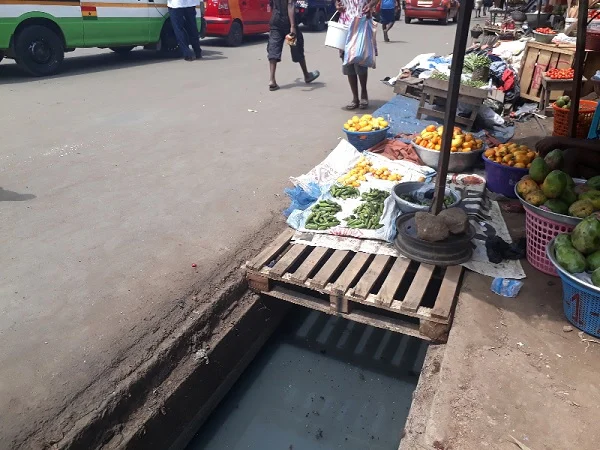
Food sold beside open gutters continues to pose a serious health threat, prompting the Food and Drugs Authority (FDA) to renew its warning to the public against purchasing meals prepared in such environments.
The Authority says the persistent practice of cooking and selling food in unsanitary locations remains one of the biggest obstacles to improving food safety nationwide. Speaking on Citi FM on Tuesday [February 3, 2026], Deputy Chief Executive Officer of the FDA’s Food Division, Mr Roderick Daddey-Adjei, stressed that the agency would not support food vending in clearly unsafe surroundings.
“Food should not be sold by a gutter, and we will not defend that,” Mr Daddey-Adjei said.
He noted that the problem has deep roots, describing it as a behavioural and cultural issue that requires both stronger enforcement and changes in public attitudes toward hygiene.
“We have developed a bad culture over time. Sanitation and education must be taken seriously. If you care about food safety, a food seller, whether a waakye seller, kebab seller or kenkey seller, should not be operating next to an open gutter,” he said.
Beyond regulatory action, Mr Daddey-Adjei emphasised the influence consumers wield in shaping food safety standards. He urged the public to avoid patronising vendors who operate in risky conditions, arguing that consumer choices can push sellers to adopt safer practices.
“You need to educate the consumer so they can make informed choices. Without them, this will not work. The numbers are worrying, and enforcement on its own will not solve the problem,” he explained.
He revealed that the FDA has intensified community outreach efforts, targeting markets and public spaces to promote hygiene awareness and encourage safer food handling.
“The FDA goes from market to market. We meet vendors, we engage market queens, and we teach the basics of food hygiene and handwashing. This work continues, but consumers also need to take responsibility,” he added.
Despite these efforts, enforcement remains complicated due to the sheer number of informal food vendors operating across the country. Mr Daddey-Adjei said monitoring responsibilities are shared with local authorities, although oversight is sometimes inconsistent.
“The task is huge. Staffing is a challenge. Local assemblies are expected to monitor basic sanitation and hygiene, but our checks show that sometimes it is done and sometimes it is not,” he said.
He explained that the Public Health Act, 2012 (Act 851) mandates that all food vendors, including mobile sellers, must secure permits and meet established hygiene requirements before conducting business. However, he acknowledged that adherence to these regulations is still limited.
Mr Daddey-Adjei linked poor hygiene practices directly to public health risks, pointing to last year’s cholera outbreak which spread from the Western Region to Central and Greater Accra.
“When people understand the need to comply, they will do what is expected. Food safety affects everyone because when people fall sick, the impact is felt by all,” he said.
He reiterated that public cooperation remains one of the most effective ways to drive change, encouraging people to be deliberate about where they purchase food.
“If people stop buying food sold next to gutters and other unsafe places, vendors will be forced to change how they operate. That is one of the strongest tools available to us,” Mr Daddey-Adjei reportedly stated.
