
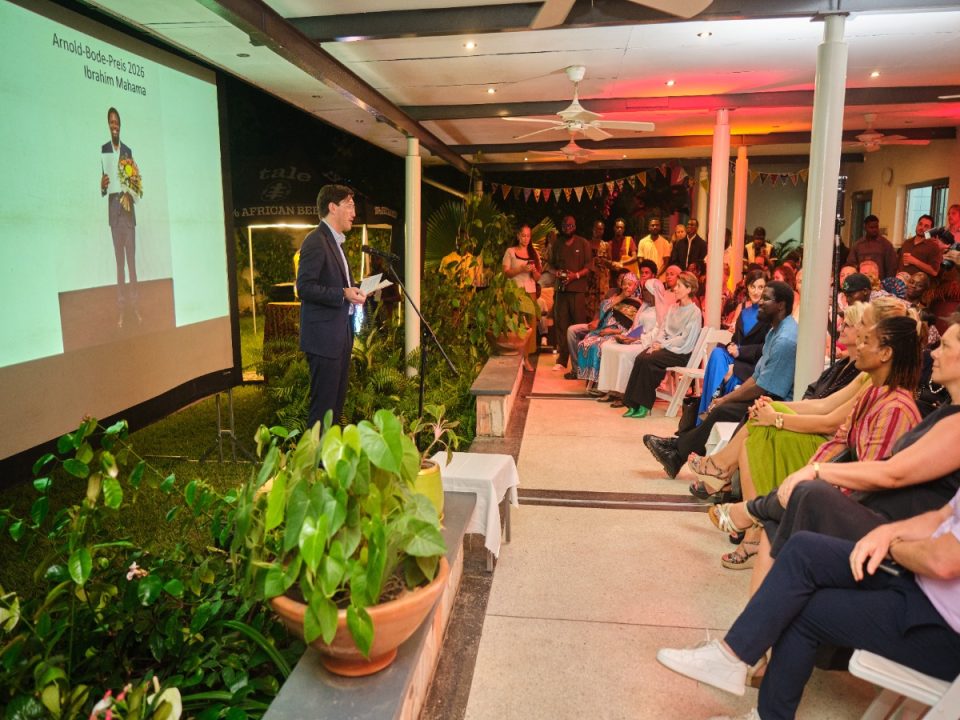
Ghanaian artist Ibrahim Mahama’s international influence and growing contribution to the country’s cultural development have been celebrated at a reception hosted by Germany’s Ambassador to Ghana, H.E. Frederik Landshöft, and Ms. Lisa Landshöft in Accra.
The gathering, held at the German Residence, honoured Mahama following his selection as the recipient of the prestigious 2026 Arnold Bode Prize, an award presented by the City of Kassel in Germany.
The occasion recognised Mahama’s impact on contemporary art, his growing international profile and his efforts to create opportunities for artistic development in Ghana. It also drew attention to the cultural and institutional ties connecting Ghana and Germany through years of artistic collaboration.
Established in 1980, the Arnold Bode Prize commemorates Arnold Bode, the founder of documenta, one of the world’s leading exhibitions of contemporary art, hosted in Kassel.
Mahama’s association with the German city gained prominence during documenta 14 in 2017. His installation, Check Point Sekondi Loco. 1901–2030. 2016–2017, reimagined the historic Torwache complex through an extensive arrangement of stitched-together jute sacks incorporating parts of old Henschel locomotives.
The work reflected the artist’s distinctive approach to transforming discarded and overlooked materials into large-scale artistic statements.
Mahama has built an international reputation through installations that incorporate used jute sacks, railway components and other reclaimed materials. His artistic practice examines the histories of labour, migration, colonialism and global trade, often using ordinary objects to reveal the human experiences and historical forces behind them.
Ambassador Landshöft praised this distinctive approach, highlighting the way Mahama gives discarded materials renewed significance.
“What fascinates me most is the way you give objects from the past a new life, a new context and a new meaning.”
Mahama’s professional relationship with Germany extends beyond documenta 14. He received a fellowship from the DAAD Artists-in-Berlin Programme in 2017 and held an exhibition at the daadgalerie in Berlin the following year.
His continued engagement with the DAAD and Goethe-Institut has also contributed to artistic collaboration and cultural dialogue between the two countries. Ambassador Landshöft described these partnerships as an example of the lasting value of international cultural cooperation.
“They show what cultural exchange can achieve when it becomes a lasting relationship.”
While Mahama’s artistic achievements have earned him recognition across the international art scene, his work in building cultural institutions in Ghana has become another important part of his legacy.
Through the Savannah Centre for Contemporary Art (SCCA), Red Clay Studios and Nkrumah Volini, all located in Tamale, he has created platforms that support exhibitions, research, education and artistic experimentation.
These initiatives provide opportunities for young people and emerging artists to explore their creativity, develop their skills and engage with contemporary artistic practices.
The recognition carries an additional significance because the Arnold Bode Prize bears the name of the man behind documenta, while its 2026 recipient has also established cultural spaces that are expanding opportunities for artists beyond the traditional international art centres.
Ambassador Landshöft drew attention to Mahama’s commitment to nurturing younger generations, describing it as a central part of his contribution to Ghana’s cultural development.
“For you, the next generation is at the heart of what you are building.”
He further underscored the importance of developing artistic institutions outside established global cultural capitals, allowing Ghanaian and other African artists to build independent platforms, express their perspectives and participate more actively in international exchanges.
The reception attracted members of Ghana’s arts and cultural community, representatives of the DAAD and Goethe-Institut, as well as other partners who have supported artistic cooperation between Ghana and Germany.
A conversation between Mahama and German artist Rebekka Macht also formed part of the programme, providing an opportunity to explore the importance of artistic dialogue and the exchange of ideas across different cultural backgrounds.
Congratulating Mahama on the honour, the German Ambassador acknowledged the wider significance of his achievements, noting how his work connects historical experiences with contemporary artistic expression while creating institutions capable of supporting future generations.
