
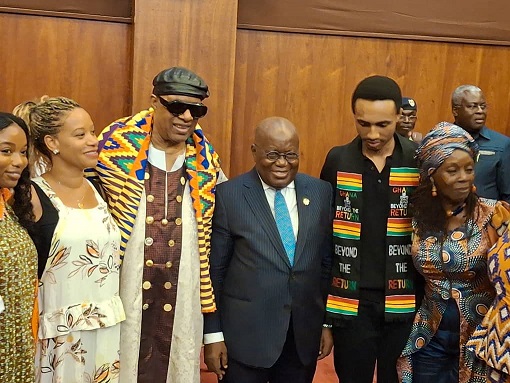
President Nana Addo Dankwa Akufo-Addo has conferred a Ghanaian citizenship status on American musician and songwriter Stevie Wonder.
Mr. Wonder who is in Ghana with his family will hold both his American citizen and that of Ghana.

At a brief ceremony at the Jubilee House, the renowned singer, expressed delight at the honour done him.
“I guess it’s just the lineage I felt Ghana, I felt my civilisation was there and I was there where it began. So, I thank all of you so very much. I always say this is the beginning, [the best part of the rest of my life got to do God’s promised],” he stated.
Profile of Stevie Wonder
Stevie Wonder (born May 13, 1950, Saginaw, Michigan, U.S.) is an American singer, songwriter, and multi-instrumentalist, a child prodigy who developed into one of the most creative musical figures of the late 20th century.
Stevie Wonder playing the bongos in the early 1960s when he was known as Little Stevie Wonder. Stevie Wonder in the early 1960s when he was known as Little Stevie Wonder.
Blind from birth and raised in inner-city Detroit, he was a skilled musician by age eight. Renamed Little Stevie Wonder by Berry Gordy, Jr., the president of Motown Records—to whom he was introduced by Ronnie White, a member of the Miracles—Wonder made his recording debut at age 12. The soulful quality of his high-pitched singing and the frantic harmonica playing that characterized his early recordings were evident in his first hit single, “Fingertips (Part 2),” recorded during a show at Chicago’s Regal Theatre in 1963.
But Wonder was much more than a prepubescent imitation of Ray Charles, as audiences discovered when he demonstrated his prowess with piano, organ, harmonica, and drums. By 1964 he was no longer described as “Little,” and two years later his fervent delivery of the pounding soul of “Uptight (Everything’s Alright),” which he also had written, suggested the emergence of both an unusually compelling performer and a composer to rival Motown’s stable of skilled songwriters. (He had already cowritten, with Smokey Robinson, “The Tears of a Clown.”)
Over the next five years Wonder had hits with “I Was Made to Love Her,” “My Cherie Amour” (both cowritten with producer Henry Cosby), and “For Once in My Life,” songs that suited dancers as well as lovers. Where I’m Coming From, an album released in 1971, hinted not merely at an expanded musical range but, in its lyrics and its mood, at a new introspection. Music of My Mind (1972) made his concerns even more plain.
In the interim he had been strongly influenced by Marvin Gaye’s What’s Going On, the album in which his Motown stablemate moved away from the label’s “hit factory” approach to confront the divisive social issues of the day. Any anxieties Gordy may have felt about his protégé’s declaration of independence were amply calmed by the run of recordings with which Wonder obliterated the competition in the mid-1970s. Talking Book (1972), Innervisions (1973), Fulfillingness’ First Finale (1974), and Songs in the Key of Life (1976) were all regarded as masterpieces, and the last three of them won a slew of Grammy Awards, each of them being named album of the year. Those albums produced a steady stream of classic hit songs, among them “Superstition,” “You Are the Sunshine of My Life,” “Higher Ground,” “Living for the City,” “Don’t You Worry ’Bout a Thing,” “Boogie On Reggae Woman,” “I Wish,” and “Sir Duke.”
